Prosperity Horse runs at five different returns, not one
Prosperity Horse is a Habanero slot built on seven reels and five rows, and the single most useful thing to know about it is that it has no single return. The studio supplies it in five configurations, from 86 per cent at the bottom to 98 at the top, and the operator that installs it decides which one its players get. Everything else on this page follows from that.
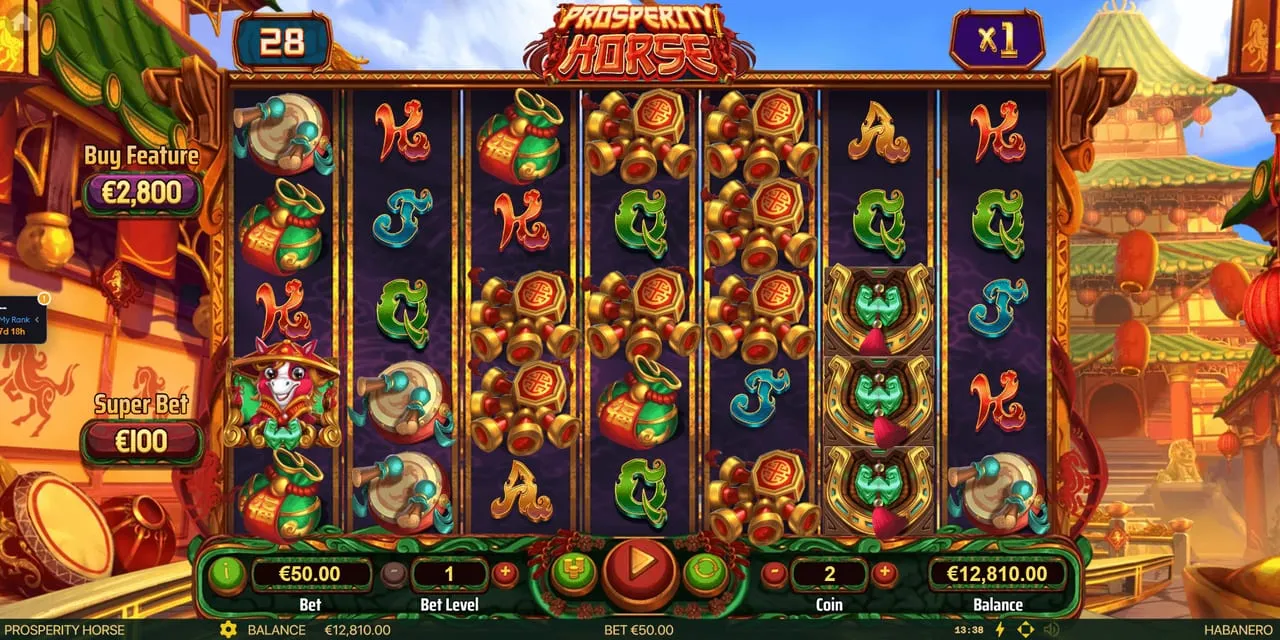
The shape of the game, in six rows
- StudioHabanero
- Gridseven reels, five rows
- Lines28, rising to 58
- Volatilityhigh
- Return86, 92, 94, 96 or 98 per cent
- Ceilingx22,360
Can a casino change the return on a slot?
On most titles, no. On this one, the studio hands the operator a choice of five.
A slot usually arrives at a casino as one mathematical model with one long-run return, and the casino installs it as it is. A good many titles, though, are built and certified in several variants of the same game — identical artwork, identical features, a different paytable underneath — and the operator picks one when it integrates the title. Prosperity Horse is one of those. Our source for this game lists its available configurations as 86, 92, 94, 96 and 98 per cent, and the gap between the ends of that range is twelve percentage points. That is not a rounding difference or a regional footnote. Between the lowest build and the highest one, the long-run cost of the same thousand spins roughly sextuples.
None of that is a secret, and it is not unique to this studio either: the practice of shipping one game in several certified return variants is openly described by suppliers and by operator-facing writers in the industry, usually in the context of margin. What is unusual about Prosperity Horse is only how wide the spread is. A title offered at 94 and 96 is a title where the choice barely matters to a reader. A title offered at 86 and 98 is a title where the choice is the most important number attached to it, and where any page printing one figure and calling it the RTP is wrong five times out of five.
Where to find the figure your game is actually running
The figure in force is inside the game, not outside it. Habanero titles carry an information panel reachable from the game interface, and the return printed there belongs to the build that particular cashier installed. That is the only place the answer exists for a given player, because the answer is a property of the operator's integration rather than of the game as the studio ships it.
So the practical instruction is short and slightly unglamorous: open the game at the operator you intend to use, open its information panel, and read the number there before anything else. If the panel shows 98, that is the build in front of you. If it shows 86, that is also the build in front of you, and it is the worst of the five. Two operators can hold the same artwork, the same features and the same ceiling, and differ by twelve points of return, and nothing on the outside of the game announces which is which.
This site will not guess on a reader's behalf. It cannot: it is not an operator, it holds no integration, and the one honest thing it can do with five numbers is print all five and say where the sixth piece of information lives.
It is worth saying what the figure does and does not mean once it has been found. A return is a long-run property of the model, settled over a span of spins far longer than anyone sits through, and it describes the whole population of outcomes rather than any session inside it. At 98 per cent a bad evening is still a bad evening. What the number genuinely tells a reader is the cost of the hobby per unit of stake over time, and on this title that cost varies between two operators by a factor of seven for an identical-looking game. That is the only reason to go looking for it, and it is a sufficient one.
Why outside pages print a single number, and three different ones
96.66, 96.83 and 97.7 per cent are all in circulation for this title. None is one of the five.
Listing sites are built around a database row, and the row has one field for the return. Faced with a game that has five, the field gets filled with something: a figure read off one lobby, a figure inherited from a feed, or a figure that is simply the sort of number a slot of this kind usually has. One large catalogue prints 96.66 for this title. A review site prints 97.70 and describes it as the highest value. An operator lobby listing Habanero games prints 97.7 beside the name. A third page prints 96.83, although that one turns out to be describing a different game altogether, which is the next section.
It would be easy, and wrong, to average those into something confident. The useful observation is the opposite one: four independent pages reaching four different answers is what a configurable title looks like from the outside. Each of them is reporting honestly on something — one build, one feed, one assumption — and the disagreement is the evidence. A reader who has met one of those numbers elsewhere has not been lied to so much as shown one card out of five.
The same catalogues are worth reading for the parts that do not vary. They agree with our source on the studio, on high volatility, on seven reels, and on the shape of the features. One of them also states a stake range of 0.25 to 10,000 in its own currency column and a maximum win per line of twenty-eight times, and in the same breath answers the question “how much can you win” with twenty-eight — a figure it derives by multiplying coins per line by the top symbol, which is not what a ceiling of x22,360 means at all. The same page's paytable blurb calls the game Starburst and gives it five reels. Catalogue data is useful and it is not careful, and this page tries to be clear about which parts are which.
Two 2026 slots carry this name, and only one is the Habanero game
There is a second slot called Prosperity Horse, released in the same year by Nextspin, and a major catalogue files the name under that studio. It is not a variant or a sequel. It is a futuristic Lunar New Year game with cascading reels, a progressive multiplier, a free spins round of its own name and a count of ways to win in the tens of thousands. Two demo sites carry that version, and one of them is where the 96.83 figure comes from.
That matters more than a naming curiosity usually would, because the two games share a theme as well as a title: both are red-and-gold horse-year slots released into the same crowded corner of the market. Every figure attached to one of them is wrong for the other. The Habanero title is seven reels by five with 28 lines rising to 58, locked horse Wilds, Multiplier Gates, Red Envelopes and a x22,360 cap. If a page offers a Prosperity Horse with cascading reels or a five-figure count of win ways, it is describing the other game, whatever the heading says.
This site is about the Habanero one throughout, for the plain reason that the Habanero one is what our source describes, down to the line range and the ceiling.
What a high-volatility rating means next to a x22,360 cap
Both our source and the trade coverage of the launch file this game as high volatility.
High volatility and a ceiling of twenty-two thousand times the stake are the same statement said twice. A game cannot reach that far and also pay often: the money has to come from somewhere, and where it comes from is the long run of spins that return nothing. The feature set is built to match. The horse Wild only locks once it has been part of a win, Multiplier Gates multiply against each other rather than adding, and the accumulated multiplier survives into the bonus round instead of resetting. Mechanics that compound are mechanics whose best outcomes are rare and whose ordinary outcomes are thin.
Which build is running changes that balance without changing the ceiling. x22,360 is reachable at 86 per cent and at 98 per cent alike; what differs is how much of the model's budget is spent on everything short of it. So the ceiling is the one figure on this site that can be printed flat, and it is the figure under the button at the top of every page for exactly that reason.
Free play without an account, and what it does not tell you
A demo build of the Habanero title runs in catalogues and in operator lobbies with no registration, no deposit and nothing to install — it is a browser game, and anything presented as a download of it is something else. A demo is a genuinely good way to learn where the Gates appear, how long a locked Wild stays put and what the envelope reveal looks like before any money is involved.
It is a poor way to learn the return. A demo build has whatever configuration its host integrated, which need not be the one the same operator runs for real-money accounts and certainly need not be the one a different operator runs. Session results in a demo tell you nothing about the model either: high volatility means a few hundred spins is noise at any of the five settings. The thing worth carrying out of a demo is familiarity with the screen. The number still has to be read off the information panel at the cashier you actually use.
This site hosts no game, embeds no game and links to none. It links to one operator, through the button at the top, and says so in the footer of every page.
Questions this title keeps raising
- What is the RTP of Prosperity Horse?
- There are five. Our source lists builds at 86, 92, 94, 96 and 98 per cent, and the operator installing the game runs one of them.
- So which one am I playing?
- Whichever the operator switched on. The game's information panel shows the figure in force there, and no outside page can know it.
- Can a casino change it after I have played?
- It can run a different build from its neighbour and change the one it deploys. It cannot alter a round already under way.
- Why do other pages print 96.66 or 97.7 per cent?
- Because a listing template wants one number. Those are single readings, and neither is any of the five.
- How much can the game pay at most?
- x22,360 of the stake. That figure holds across every build, and our source and an outside review give it identically.
- Which studio makes the Prosperity Horse slot?
- Habanero, a Malta-based studio also listed as Habanero Systems.
- Is there more than one slot called Prosperity Horse?
- Yes. A Nextspin release carries the same name with cascading reels and a different grid. Its figures belong to that game.
- Is there a no-registration Prosperity Horse demo?
- Catalogues and operator lobbies run a no-account demo of the Habanero title. This site runs no game of its own.
The grid those returns are measured over is set out on the feature page, the multiplier that does most of the work on the locked Wilds page, and every figure with its source on the figures page. The bonus round has its own page, and so does the phone layout.