Prosperity Horse features work as one connected system
Four named mechanics sit on the same seven-by-five field, and each of them writes its state onto the grid rather than into a separate panel. The line count climbs, Wilds lock in place, Gates show numbers, envelopes resolve into values or symbols. Read separately they look like a long feature list; read together they are one machine, and the order they resolve in is what makes the screen legible.
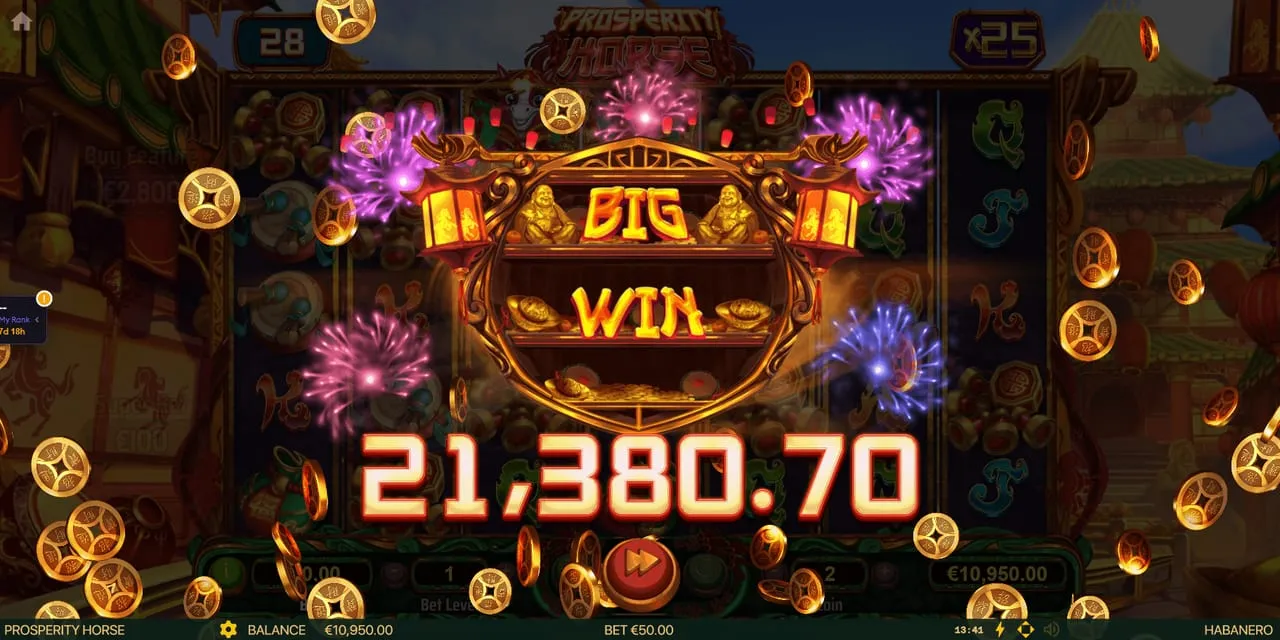
Ways to win on a seven-reel grid
Thirty-five positions, twenty-eight lines at rest, fifty-eight once a win has landed.
Seven reels with five visible positions each gives thirty-five cells, which is a wide field by the standards of this kind of game — roughly a third more than the five-by-five layouts that dominate the category. Width is not decoration here. Each of the three base-game mechanics needs somewhere specific to live: a locked Wild needs a position it can hold without burying a payline, a Multiplier Gate needs a frame large enough to read a number inside, and a Red Envelope needs enough contrast around it to be told apart from ordinary artwork. On a narrower grid those three would be competing for the same cells.
The line structure is the unusual part. Twenty-eight lines are active in the ordinary state, and a winning spin can raise the count as high as fifty-eight. That makes line coverage a piece of current state rather than a specification: the number on screen describes where the game is now, not what the game is. Our source is explicit that the increase is tied to a win rather than to a random event, and the trade write-up of the launch, whose stated source is the studio's own announcement, repeats the same twenty-eight-to-fifty-eight range.
Additional features expand what one spin can do
The horse Wild is the anchor. It substitutes like any Wild, but once it has taken part in a winning combination it locks onto its position, and every further Wild that arrives raises an active multiplier that does not reset between spins. So a spin is not evaluated in isolation: it inherits whatever the previous ones left behind.
Multiplier Gates are the second layer, and the detail that matters about them is the arithmetic. Several revealed Gate values multiply against one another rather than being summed. Two modest numbers therefore behave very differently here than they would in a game that adds them, and the interface has to show both the individual frames and the combined total for the screen to make sense at all.
Red Envelopes are the third, and they are the only one of the three with two possible outcomes. An envelope either reveals a cash value, which is read directly off the grid, or turns into one of the high-paying symbols, which changes the symbol field and is then evaluated by the ordinary line rules. Our source and the trade coverage describe the same pair of outcomes in the same order.
Free Games is the fourth, and it is where the other three stop being independent: the multiplier built up in the base game stays active inside the round, and expanding symbols turn up more often while it runs. That continuity is the point of the design and it is what the studio's own quoted description emphasises — a sense of development through a session rather than a bonus round that starts from zero.
How to play, and the two switches on the left of the screen
Bet level, coin size, spin. Two optional controls sit beside them, and both cost money.
The staking model is the studio's usual one: a bet level and a coin size set independently, a maximum-stake shortcut, autoplay with its own limits, and a quick-spin toggle in the settings. A catalogue that walks through the interface describes two further controls on the left-hand side, and both are worth understanding before they are touched. One is a feature buy, which opens a purchase window and places three, four, five, six or seven scatters directly; the same page lists the free games those counts award as ten, fifteen, thirty-five, forty-five and sixty.
The other is a Super Bet switch. According to the same walkthrough it raises the stake by twenty-five per cent and improves the chance of triggering the free games round, and it can be turned off again at any point. Neither control changes the configured return, and neither is a strategy: a paid entry and a raised stake are both ways of spending more per round, and the game's own model is what decides what comes back. They are described here because they are on the screen and a reader will meet them, not as something to do.
One qualification on the buy. The trade write-up says plainly that it is available to players in certain markets, which is the industry's way of saying its availability follows the rules where the account is held. Whether the button is there at all is a matter for the operator the reader uses, not for this page.
Tools an operator can switch on around the game
Our source lists, alongside the game's own features, support for respins, multipliers, Jackpot Race, UP Tournaments and WinReplay. Those are not mechanics of Prosperity Horse. They are platform-level options an operator can enable: a timed jackpot competition across a set of titles, a tournament framework, and a facility for replaying a past result. The trade coverage mentions the jackpot race and the buy in the same breath and calls them tools aimed at engagement, which is an honest description of what they are for.
The distinction is worth keeping because a feature list that mixes the two makes the game look busier than it is. On the reels there are four things happening: lines growing, Wilds locking, Gates multiplying and envelopes resolving. Everything else in the list is something wrapped around the game by whoever is running it, and it may or may not be present where a given reader plays.
What the paytable pays, and what it does not count
Seven paying positions per line at the top end, and a ceiling that has nothing to do with the top symbol.
The symbol set runs from card-style low values through decorative objects to premium festival characters, with the golden horse above all of them. A published paytable shows awards at three, four, five, six and seven positions, which is what seven reels makes possible: a combination can occupy the entire width of the screen. The top symbol's seven-of-a-kind award on that table is twenty-eight times the line stake.
That number has caused trouble elsewhere. A catalogue answers the question of how much the game can pay with twenty-eight, having multiplied coins per line by the top symbol and stopped. The ceiling our source names is x22,360 of the total stake, and the distance between the two figures is the whole feature set: locked Wilds compounding a multiplier, Gates multiplying against each other, envelopes converting into premium symbols, and the whole accumulated state carried into a free games round. A paytable row describes one line in the base game. It is not a ceiling and it was never meant to be read as one.
Five questions about the feature set
- How many lines are in play?
- Twenty-eight to begin with, rising to fifty-eight after a winning spin. The count is part of the visible state, not a fixed entry in a table.
- What does a symbol need to pay?
- Three positions at the short end and seven at the long one. Seven reels means a combination can run the full width of the screen.
- Which features are actually named?
- The locked horse Wild, Multiplier Gates, Red Envelopes and Free Games. Everything else listed around the game is an operator-side tool.
- Is there a feature buy?
- The studio lists one, and the trade coverage says it is offered to players in certain markets only. Whether it appears depends on where the account sits.
- What is Super Bet?
- A switch one catalogue describes on the game's own interface: it raises the stake by a quarter and improves the chance of reaching Free Games.
Each named mechanic has its own page: the locked Wild and the Gates, the envelopes and the bonus round. The returns these features are priced against are on the opening page, and the full figure list with sources on the figures page.