Prosperity Horse red envelopes resolve in one of two ways
The red envelope is the most recognisable icon on this grid and the most frequently misdescribed. It is not the scatter and it does not open the bonus round. It is a prize symbol with two possible resolutions, and which of the two a given envelope takes is not predictable from looking at it: both start as the same piece of artwork and separate only when they resolve.
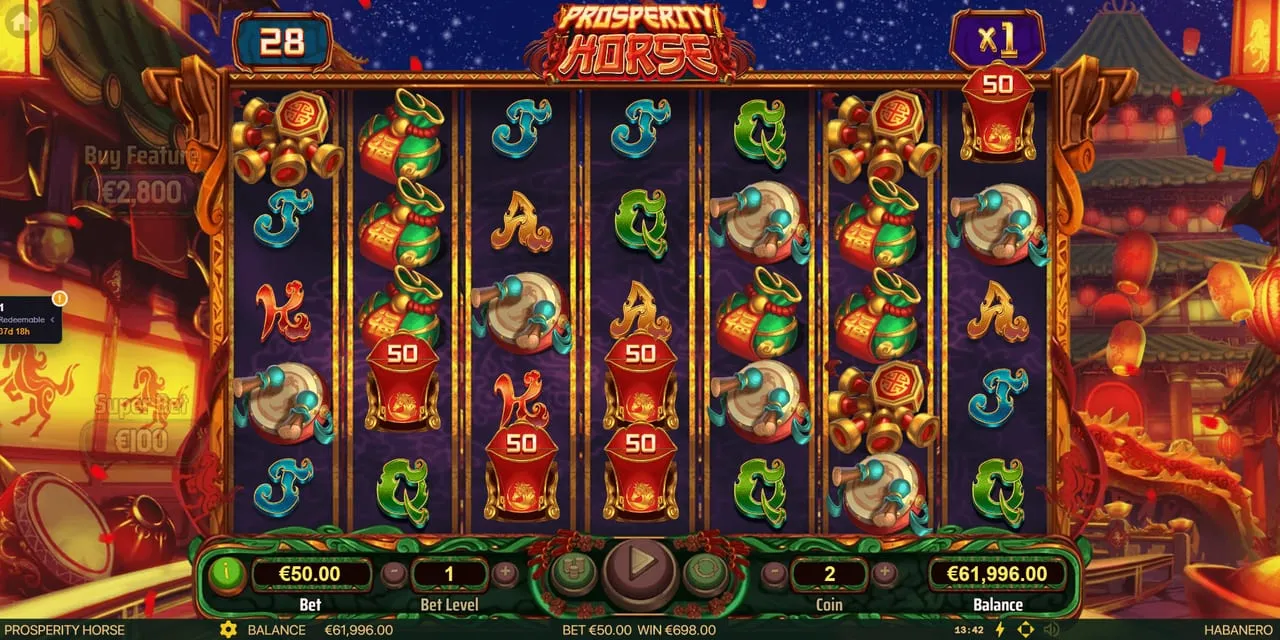
A cash value read straight off the grid
The first resolution puts a number on the symbol and settles there.
An envelope can reveal a cash value, printed on the feature symbol where it landed. It is worth noticing how unusual that is on an ordinary paying grid. Every other symbol in the game is worth something only in context: which line it sits on, how many of its kind are beside it, what multiplier is currently active. An envelope with a number on it is worth the number. The reveal carries its own information, and a reader does not have to work out anything to know what has happened.
That is also why the interface treats the reveals as a layer of their own. Several envelopes can occupy a wide grid at once, so the values need number panels legible at a glance and a background restrained enough not to compete with them, while the locked horse Wilds, the Gate frames and the line counter all keep their existing positions. Our source describes exactly that arrangement, and the trade coverage of the launch, sourced to the studio's own announcement, calls the same outcome an instant payout.
A change into a high-paying symbol
The second resolution is different in kind. Instead of showing a value the envelope becomes one of the high-paying symbols, which alters the symbol field and is then evaluated by the ordinary line rules. A transformation can complete a combination that was one position short, and on a seven-reel grid that is a real possibility rather than a theoretical one: a line can run the full width, so a single converted position in the middle of the screen can turn a dead spin into a long one.
The trade write-up describes this as the envelope transforming into higher-value symbols, which matches our source's wording about high-pay transformations. Both accounts put the two outcomes in the same order and neither adds a third, which is unusual enough to be worth saying: outside listings for this title disagree about the return, about the maximum, and in one case about which studio made it, but on the envelope they are consistent.
One thing neither source states is the proportion. Nothing we hold says how often an envelope takes the cash route rather than the symbol route, so nothing here guesses at it. An envelope on the grid means one of two things is about to happen, and which one is not information that exists outside the game.
Why the envelope is not a scatter, and the Gong is
The bonus round needs a different symbol entirely, and mixing the two misreads the whole screen.
Envelopes resolve where they land and the spin carries on. What opens Free Games is a separate scatter symbol: the trade coverage puts the trigger at three or more scatters, and a review of the title identifies that symbol as a Gong and says it pays from three to seven positions anywhere in view. A catalogue describing the game's own buy window lists the same ladder of three to seven scatter symbols. Three independent accounts, one symbol, and it is not the envelope.
This distinction is easy to lose because the legacy description of this game said envelopes "scatter across the reels", using the word in its ordinary English sense rather than its slot-machine one. In this category the word has a job, and giving it to the wrong symbol changes what a reader expects from a spin. Four envelopes on screen is a good spin. Four envelopes on screen is not a bonus round, and a page that implies otherwise sets up a disappointment that the game never promised.
Where envelopes sit among the other three systems
Four things can be true of one spin at once, and keeping their roles separate is how the grid stays readable. The horse Wild locks after a win and feeds a multiplier that does not reset. The Gates reveal values that multiply against each other. The envelopes resolve into cash or into premium symbols. And the line count may have climbed from its base twenty-eight towards fifty-eight because something paid earlier.
Our source is careful about this and says so directly: keeping the three feature roles separate is essential to understanding the product. It is a fair point, and it is the reason this site gives each of them a page instead of one long feature list. The envelope is the easiest of the three to recognise and the easiest to misunderstand, because it is the only one whose meaning is not fixed until it opens.
The theme carries all of this without getting in the way. Red and gold, a festival frame, lantern light, a horse at the centre — the envelope belongs to that world culturally and has a precise mechanical job inside it. That is a tidier piece of design than the category usually manages, and it is the part of the game that outside reviews tend to praise.
What outside listings call this feature
Consistent on the envelope, unreliable on almost everything with a number in it.
Third-party pages for this title are a mixed bag, and it is useful to know which parts of them to trust. On the envelope they agree with each other and with our source. On the figures they do not agree about anything: three different single returns are in circulation, one page answers the maximum-win question with a paytable row, another files a differently-built slot of the same name under a different studio, and one puts a paytable blurb on the page that names a completely unrelated game.
None of that makes them useless. It makes them a source for the shape of the game and not for its arithmetic, which is the division this whole site is organised around. The envelope is a good example of the shape half: four pages, one description, no contradiction. The return is the other half, and it has a page of its own.
Five questions about the envelopes
- What can an envelope reveal?
- One of two things: a cash value shown on the symbol itself, or a change into one of the high-paying symbols.
- Is the envelope the scatter?
- No. The symbol that opens Free Games is a Gong. Envelopes pay or transform where they land and do not start the round.
- Can both outcomes happen on one spin?
- Several envelopes can land at once, and each resolves on its own, so a single spin can show a cash reveal and a transformation together.
- Does a transformed envelope pay by the normal rules?
- Yes. Once it has become a premium symbol it is evaluated by the line rules like any other symbol in that position.
- Do envelope values interact with the multiplier?
- They are a separate system from the locked Wilds and the Gates. Our source keeps the three roles apart and so does this page.
The multiplier systems the envelopes sit beside are on the locked Wilds page, the symbol the bonus actually needs on the Free Games page, and the grid all three run on the feature page. For why no single return figure appears anywhere here, see the opening page.