Prosperity Horse wild multiplier does not reset between spins
Most slot multipliers live for one evaluation and then disappear. This one does not. The golden horse Wild fixes itself to the grid as soon as it has helped pay something, each further Wild lifts the running value, and that value carries into the spins that follow and into the bonus round. Multiplier Gates then sit on top of it with arithmetic of their own, and the two systems are deliberately drawn to look nothing alike.
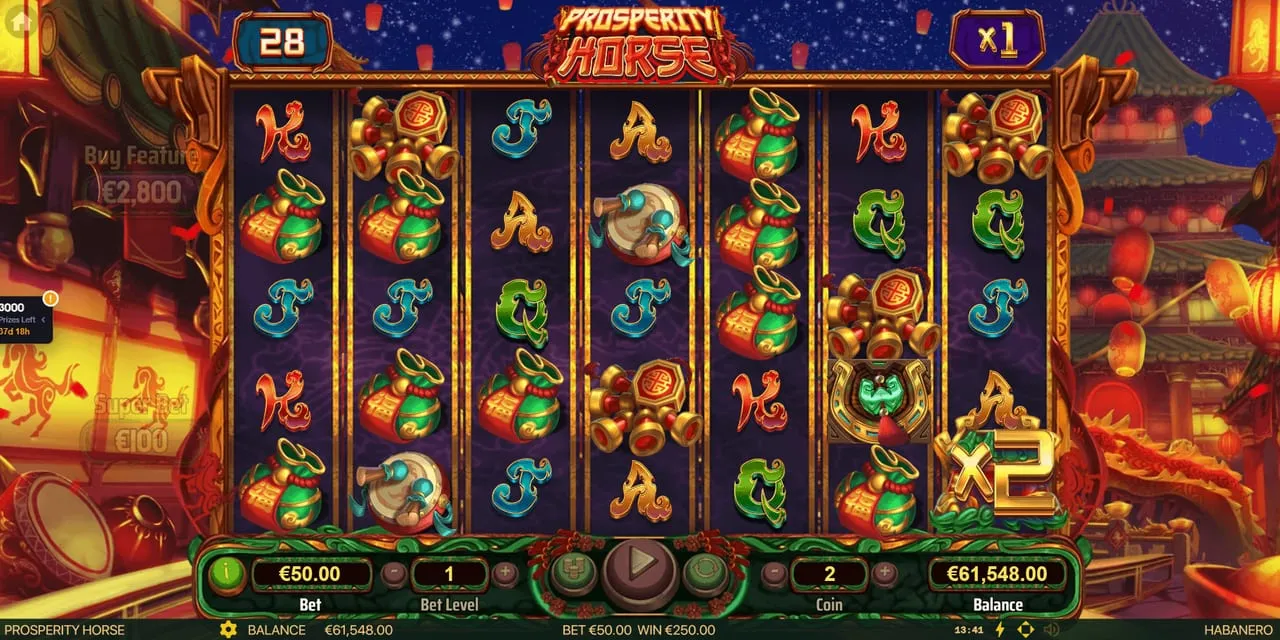
The horse is the Wild, and a win is what makes it stick
The trigger is a confirmed win, not the arrival of the symbol.
The title character is the special symbol, which is less common than it sounds: in a great many games the creature on the cover is a high-paying picture and the mechanical work is done by something else. Here the golden horse is the Wild, and the condition for it to lock is specific. It has to have been part of a combination that paid. A horse that lands somewhere useless is an ordinary Wild for that spin and then goes away with the rest of the reel.
That condition is what makes the feature readable. A locked horse on the grid is not decoration and not a random event — it is a record that something paid, and the position it holds is the position it paid from. Our source describes the behaviour in those terms, and the trade write-up of the launch, whose stated source is the studio's own announcement, puts it the same way: the Wild activates when it forms part of a winning combination and then remains fixed on the reels.
A multiplier that carries forward instead of restarting
Each further Wild that arrives adds to an active multiplier, and the multiplier does not reset when a spin finishes. The trade coverage says so in as many words — the value continues to carry forward into subsequent spins instead of resetting — and our source calls the system non-resetting on its own feature page. That single property changes what a session looks like. In a game with a per-spin multiplier, every round starts from nothing and the best result available is bounded by what lands in that round. Here the state accumulates, so the interesting outcomes are built across a run of spins rather than found in one.
It also explains the high volatility rating, which both of our sources give the game. A compounding system spends most of its budget on the small number of sequences where the compounding actually happens; the ordinary spin in between has to be thinner to pay for them. And it explains the shape of the ceiling: x22,360 is not a single symbol combination, it is what a stacked multiplier applied to a wide grid can reach at full stretch.
One sibling title from the same studio works the same way, and the trade write-up makes the comparison itself: an earlier release carried its own named multiplier into its free spins rather than restarting it. This is a house pattern rather than a one-off, which is mildly reassuring about the description being accurate.
Gates that multiply together rather than adding up
Two Gates showing small numbers are worth their product, not their sum.
Multiplier Gates appear on reel positions and reveal values. When more than one is active, our source states that the revealed numbers multiply together. That is the detail to hold on to, because almost every comparable mechanic in the category adds. A pair of threes is nine here and six almost everywhere else, and a third Gate turns nine into something that no longer looks modest at all. The trade coverage adds that the Gates can appear at random and give an opportunity to raise the accumulated value further across several rounds, which places them inside the same compounding system as the Wilds rather than beside it.
Multiplication is also why the interface has to show two things at once: each Gate's own number, and the combined result. A total alone would hide where it came from; the frames alone would leave a reader doing arithmetic. Our source describes exactly that split presentation, with the combined value held close to the play area so the number and the positions responsible for it can be seen in one glance.
Reading two multiplier systems on one screen
At any moment the grid can be carrying locked horses, framed Gate numbers, envelopes waiting to resolve, and a line count that has already climbed above its base twenty-eight. Four kinds of state, on thirty-five positions. The design handles it with colour and shape rather than with panels: gold marks premium value, red marks envelopes and feature frames, the Gates get their own framing and numerals, and the background stays cool enough for all of it to separate.
The practical consequence for a reader is an order of reading. The horses say what has already paid and where. The Gate frames say what is being multiplied. The combined total says what the two of them currently come to. The line count says how much of the grid is being evaluated at all. Taken in that order the screen is straightforward; taken as one picture it is busy, which is the usual complaint about this kind of game and the reason the layout puts each piece of state in a fixed place.
What the studio says about this and what it leaves out
The mechanics are described in detail. The returns are not described at all.
It is worth being precise about where these statements come from. The grid, the line range, the locking condition, the non-resetting multiplier, the random Gates, the two envelope outcomes and the scatter trigger all appear in the trade write-up whose stated source is the studio's own announcement, and all of them match our source exactly. On the mechanics, in other words, there are two independent accounts and they agree.
On the return there is nothing from that direction at all. The announcement-sourced coverage prints no percentage, and it is the outside listings — each with one field to fill and a different number in it — that supply the figures in circulation. Our source lists five builds, 86 through 98, and says the game is supplied that way. Those are not competing claims about the same quantity; one is a description of the mechanics and the other is a description of the configuration, and a page that mixes them produces exactly the confident single number this site declines to print.
Five questions about the multiplier
- What makes the horse Wild lock?
- Taking part in a winning combination. Landing on the grid is not enough: the win is what fixes it in place.
- Does the multiplier reset each spin?
- No. Both our source and the trade coverage describe it as non-resetting, and the value carries forward into following spins.
- Do several Gate values add up?
- They multiply. Two Gates showing modest numbers produce their product, which is why the interface shows a combined total as well as each frame.
- Can a Gate and a locked Wild be confused on screen?
- They are drawn differently on purpose. A Gate is a framed number on a position, a locked Wild is the horse artwork held in place.
- Does the multiplier survive into Free Games?
- Yes. The value built up in the base game stays active inside the round rather than starting again from one.
The grid this happens on is described on the feature page, the second feature path on the envelopes page, and what the multiplier does once the bonus starts on the Free Games page. Why none of it has a single return attached is on the opening page.